
Town of Monroe City Directory Collections
No standalone, continuous printed city-directory run for the Town of Monroe in Orange County was located in the research. That finding sets the right starting point. The most useful local material is a set of named Monroe publications and Orange County research holdings, not an assumed annual directory shelf. The Orange County Genealogical Society research room in Goshen inventories the county sources and the society's Monroe publications supply town-specific names, households, deaths, church connections, and land clues.
| Collection | Years | Where Held | Access |
|---|---|---|---|
| Chronicles of Monroe in the Olden Time | Original 1898; reprint 1997 | OCGS catalog and research room | Every-name index; inspect in room or ask about the catalog copy |
| Monroe 1865 Census, related obituaries and deaths | 1865 and related historical material | OCGS catalog and research room | Publication and index consultation |
| First Presbyterian Church of Monroe history | 1784-1951 | OCGS catalog and research room | Marriages, baptisms, membership, and officers |
| Official Town of Monroe deaths | 1881-1913 | OCGS research room | Town-level death entries; compare with the proper custodian when needed |
| Orange County census, newspapers, maps, and land indexes | Varies by record set | OCGS research room and linked county resources | In-room film, reference material, and digital newspaper discovery |
Nearby directories do exist, but their labels are important. OCGS lists incomplete Middletown and Port Jervis directories for 1899-1952 and incomplete Newburgh-area directories for 1899-1956. Those can help after a documented move, yet they do not make a Town of Monroe directory run. Rochester and Monroe County directory holdings belong to a different county and must not be treated as local Town of Monroe evidence.
Town of Monroe City Directory Coverage Gap
The absence of a found continuous run changes the research question from “which annual volume?” to “which source can place this person here?” Freeland's town history has an every-name index. The 1865 census publication ties households to a period when the town's boundaries were in flux. Church history, official deaths, newspapers, maps, and deed indexes each offer a different kind of evidence. A surname may surface in one and not another because each was created for a different purpose.
Do not substitute the 1885 Rochester business directory and Monroe County directory for Orange County research. It describes the Rochester-area Monroe County, not the Town of Monroe. The same warning applies to digitized Rochester volumes and local-history databases from that area. They can be useful only when independent evidence shows that a person moved there. For a Monroe, Orange County question, record the town, village if known, Orange County, and an approximate date before searching.
Note: a catalog listing is a discovery lead, while the consulted publication page or the original civil record supplies the supporting detail.
Town of Monroe City Directory Research Room
The OCGS room is a practical access channel, not merely a web listing. The society operates from the 1841 Historic Court House at 101 Main Street in Goshen and describes volunteer research by appointment. Its room has two copiers at 10 cents per page, two microfilm or microfiche readers with a laser printer, and a Windows 10 computer without online subscriptions. Plan to bring a surname, a date range, and the town or village context. That makes a volunteer appointment more productive than a broad request for all Monroe records.
View the OCGS research room before arranging research or selecting a collection.
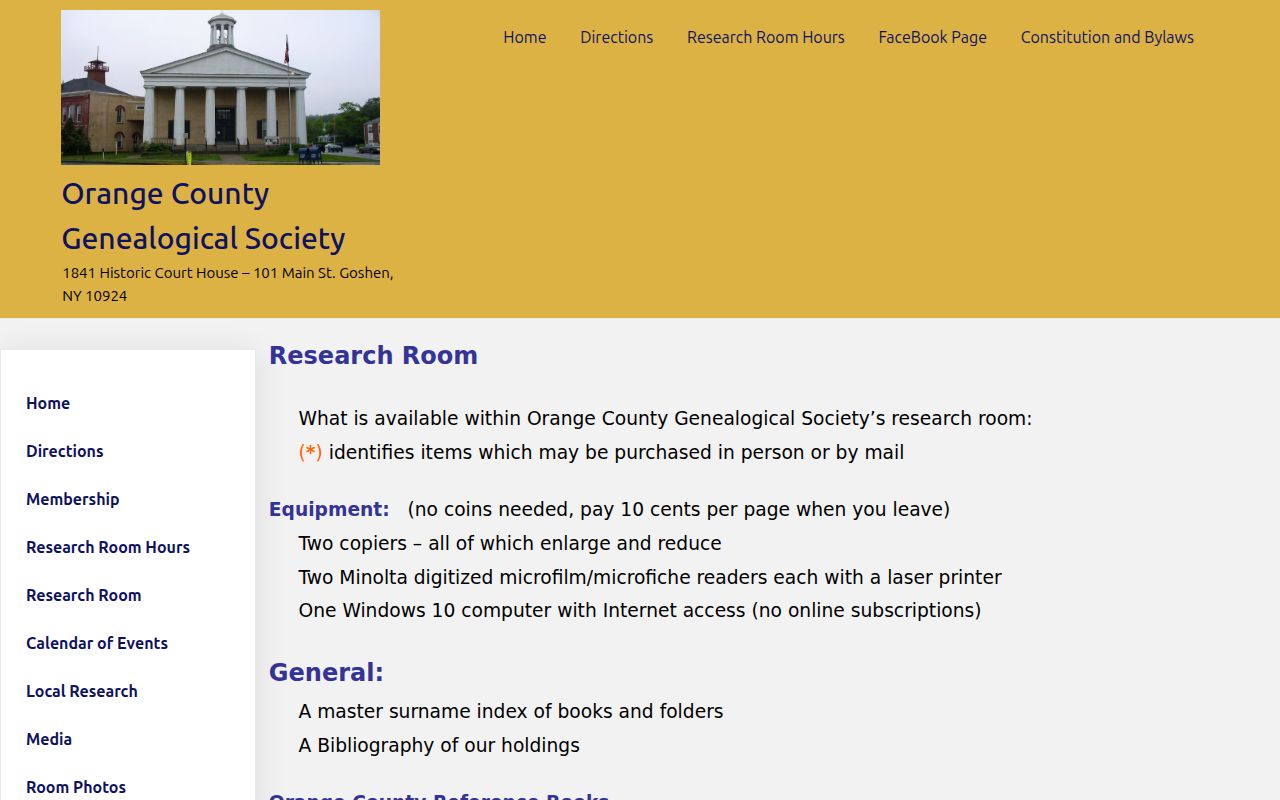
The room inventory also identifies a master surname index, bibliography, reference books, federal census microfilm for Orange and adjacent counties, New York State census material, mortality schedules, and county newspapers. Those resources give a name search several routes even without a local annual directory volume.
Town of Monroe Directory Shelf
The OCGS publication catalog identifies the strongest town-specific shelf. Daniel N. Freeland's Chronicles of Monroe in the Olden Time was first issued in 1898 and reprinted in 1997 with an every-name index. The Monroe 1865 census and related obituaries and deaths add household and death research around a period of municipal change. The First Presbyterian history reaches from 1784 through 1951 and records marriages, baptisms, membership, and officers.
For an entry inventory, write down the full publication title, compiler or author, original date and reprint date when supplied, indexed name spelling, page cited, and the kind of fact found. A Freeland entry may be a historical narrative or surname cross-reference, not proof of a street address. A church entry can identify a family connection but still needs comparison with civil, cemetery, or census evidence. Official Monroe death entries for 1881-1913 add another focused series for closing a life timeline. The room's county-wide discovery tools include grantor/grantee indexes for 1703-1891, mortgage indexes for 1703-1869, and early tax rolls for 1799-1804.
- Freeland inventory: Daniel N. Freeland, Chronicles of Monroe in the Olden Time, original 1898, reprint 1997, every-name index, OCGS catalog and research room.
- Newspaper inventory: Goshen Independent Republican, 1813-1957, OCGS microfilm; search surname, date, or event, then compare an obituary with a civil or cemetery source.
- Land inventory: OCGS grantor/grantee index, 1703-1891; search surname, town, and approximate year, then use the County Clerk for the cited liber/page and legal description.
Reading Town of Monroe Directory Entries
Because a continuous local city-directory series was not found, there is no Monroe-wide standardized entry format to promise. When a directory from another Orange County place is relevant to a documented move, or when a directory-like entry appears in a collection, read the volume's own front matter before interpreting abbreviations. The entry style may vary by publisher, place, and year. Preserve what is printed instead of expanding a mark from memory.
| Name | Record the surname and given-name spelling exactly, then note any initials or variant spelling. |
|---|---|
| Occupation | Copy the stated role or business description only when the consulted volume provides one. |
| Address | Keep the printed house number, street, village, and any residence notation together. |
| Family notation | Record a spouse, widow, parenthetical note, or household clue as printed, without treating it as a civil certificate. |
| Source citation | Keep the title, year, page, and abbreviation key with the transcription. |
- Criss-cross directory
- A street-order directory that groups entries by address rather than by surname. No continuous Town of Monroe criss-cross run was found.
- Householder index
- An index arranged around the person named as a household contact or head, which may omit other people at the address.
- Abbreviation key
- The publisher's explanation of marks and shortened words, usually placed in preliminary pages. Copy it before relying on a notation.
Town of Monroe Criss-Cross Limits
A criss-cross search can be useful for a proven later address, but no continuous Town of Monroe criss-cross directory collection was located. Do not infer a list of occupants from the tax roll or a tax mailing line. For historical address context, compare the parcel's legal and map information with the OCGS 1850 Orange County maps that name farmers, relevant census schedules, newspaper notices, and the recorded land trail. Each source answers a narrower question.
The society lists federal census microfilm for Orange and adjacent counties for 1790-1880 and 1900-1930, New York State census material for 1825-1875, and mortality schedules for 1850-1880. Its newspaper holdings include the Goshen Independent Republican, 1813-1957, and the Goshen Democrat, 1834-1933. Digital searching through Hudson River Valley Heritage newspapers can surface a notice, but title and date should be checked against the underlying collection and paired with a civil or cemetery source when possible.
Tracing Town of Monroe Households
Use a household method when trying to connect a surname to a place. Start with the most precise item already available, such as a Monroe publication page, a census household, an obituary, a church event, or a deed reference. Then move outward in time. The goal is not to force every person into a directory, but to test whether independent local sources point to the same family and place.
- Search the OCGS catalog and research-room index using the surname, spelling variants, and “Monroe, Orange County.”
- Read the cited Monroe publication page and capture the exact wording, page number, and date context.
- Pair the name with the closest available federal or New York State census schedule, noting household members and locality.
- Check church history, official death entries, cemetery material, or a newspaper notice for events that explain a move, marriage, or disappearance.
- For a land connection, carry the surname and approximate period to the grantor or grantee index, then verify the recorded instrument with the County Clerk.
A missing name has several possible explanations: the source may be incomplete, the person may have used a spelling variant, the event may have occurred in the Village of Monroe or Harriman context, or the family may have been elsewhere. Record the negative search with its exact source and years. It prevents the same narrow collection from being treated as complete later.
Town of Monroe After the Fire
Local history supplies context that a name index cannot. The Town Historian describes a disastrous 1894 fire that destroyed nearly all buildings at the heart of the settlement, followed by village boundaries established for a volunteer fire district. That story is a reason to compare photographs, newspapers, cemetery records, deeds, and municipal context rather than assuming that a surviving address tells the whole story. The town was incorporated in 1799, renamed Monroe in 1808, divided in 1863, restored in 1865, and altered again in 1889.
- 1799: the Town of Monroe was incorporated.
- 1808: Southfield was renamed Monroe.
- 1863-1865: the town was divided, then restored.
- 1889: the later Monroe, Woodbury, and Tuxedo boundary context took shape.
- 1894: a destructive fire and the village fire-district response changed the local setting.
See the Town Historian and Monroe Historical Society for the local-history contact route.
The Monroe Historical Society was established in 1974 to preserve photographs, artifacts, and written history for the Town and the Villages of Monroe and Harriman. A separate public catalog was not located, so the historian route is appropriate for a specific question about photographs or locally held material.
Town of Monroe History Partners
The Orange County research page sends town-specific questions to the local historian, family-history and cemetery questions to OCGS, land and map research to the County Clerk, and estate questions to Surrogate's Court. This division is useful because “Monroe” can refer to the town, the Village of Monroe, a postal place line, or a place in a different county.
For a family-history inquiry, bring the source citation and state the Orange County location. For an original property transfer, use the historical index only to identify a lead, then confirm the document through the County Clerk. For a historic image or local narrative, contact the historian with the surname, place, and approximate period. Those channels preserve the distinction between historical discovery and the record custodian.
Note: Town of Monroe, Orange County searches should always be labeled with the county to avoid an accidental Rochester-area result.